



Disclaimer: Early release articles are not considered as final versions. Any changes will be reflected in the online version in the month the article is officially released.
 , and National Measles Working Group,2
Author affiliation: Central Virology Laboratory, Public Health Services, Ministry of Health and Sheba Medical Center, Ramat-Gan, Israel (E. Bucris, N.S. Zuckerman, T. Levin, Y. Kanaaneh, O. Erster, V. Indenbaum, K. Friedman, D. Sofer, Y. Lustig); Gray Faculty of Medicine, Tel-Aviv University, Tel-Aviv, Israel (N.S. Zuckerman, Y. Lustig); The Center for Geographic Medicine and Tropical Diseases, The Chaim Sheba Medical Center, Tel Hashomer, Israel (E. Schwartz); Ministry of Health Division of Epidemiology, Jerusalem, Israel (E. Chernin, O. Kriger, R. Shibli, S.E. Prais); Health Intelligence, Ministry of Health, Jerusalem (S.E. Prais, D. Yakir, L.G. David); Program for Public Health, Ashkelon Academic College, Ashkelon, Israel (Z. Mor); Jerusalem Department of Health, Ministry of Health, Jerusalem (Z. Mor, N. Abramson); Tel Aviv Department of Health, Ministry of Health, Tel-Aviv (M. Savion, N. Nuss); Central District Health Bureau, Ramla, Israel (A.C. Golan, E. Avramovich); Ministry of Health Department of Laboratories, Jerusalem (E. Rorman)
Measles is a highly contagious, vaccine-preventable disease; clinical manifestations typically include high fever, maculopapular rash, cough, and conjunctivitis. Severe complications, including pneumonia and encephalitis, can occur in up to 30% of cases, and the case-fatality rate is ≈1/1,000 cases (1). Despite an effective vaccine (measles, mumps, and rubella [MMR]), measles remains a major global health concern; in 2025, Romania, Vietnam, Morocco, and the United States reported outbreaks (2–4).
In Israel, MMR vaccine coverage has declined in recent years to 83% receiving the first dose at 4,000 cases in 2018–2019 and smaller outbreaks during 2023–2024 (5–7). We report on an ongoing measles outbreak that began in Israel in April 2025.
During April 7, 2025–February 28, 2026, a total of 3,203 measles cases, including 16 deaths, were reported across Israel, the largest outbreak since 2018–2019 (8). Epidemiologic investigations found 13 case-patients had a history of travel abroad shortly before illness onset (Table). Among reported case-patients, mean age was 5.58 years (SD 9.35 years; range 1 month–73 years); 82.7% were unvaccinated, 7.1% were partially vaccinated, 2.2% were fully vaccinated, and 8.5% had unknown vaccination status.
As part of routine surveillance, 132 measles virus–positive samples collected during April 2025–February 2026 were selected for sequencing (Appendix). Samples were sequenced on the basis of the following criteria: all available imported cases, all travel-associated cases, representative samples from newly affected areas, and randomized samples collected in established outbreak locations every 2 weeks throughout the outbreak. Samples were excluded from sequencing when epidemiologic data showed that transmission occurred in established measles-positive locations (i.e., same street or household) (Appendix). Complete measles virus genomes were sequenced (9) (Appendix) and used for phylogenetic analysis to support transmission chain reconstruction. The N450 region of the measles viral genome confirmed the sequences as genotype B3, matching the reference MVs/Quetta.PAK/44.20 strain from Pakistan.
Figure 1
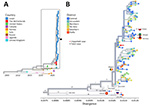
Figure 1. Phylogenetic analysis from investigation of genomic and epidemiologic insights into ongoing measles outbreak, Israel, 2025–2026. Phylogenetic tree including 132 sequences from Israel collected during April 2025–February 2026 and 29 global…
Figure 2
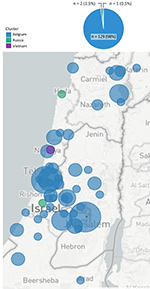
Figure 2. Geographic distribution of sequenced measles cases and importation clusters from genomic and epidemiologic investigation into ongoing measles outbreak, Israel, 2025–2026. Map displays the geographic distribution of sequenced cases by city….
Phylogenetic analysis showed the Israel sequences clustered most closely with sequences from the Netherlands and the United States collected in 2025 (Figure 1); however, because up-to-date global sequence data in public repositories are limited, intermediate diversity could be missing. The Israel sequences showed 3 likely clusters within the dominant B3 lineage, each derived from a separate documented importation: Belgium, Vietnam, and Russia. We found no spread of D8 lineage sequences imported to Israel. The Russia cluster likely originated from a documented importation from Russia (patient 4; Rehovot, May 2025) and is linked to an additional sample collected in Haifa in June 2025. That cluster is most closely related to a global sequence from California, USA (2025), differing by 7 nucleotides. Transmission in the cluster was limited to only 2 cases because close contacts were fully vaccinated and that location has high overall vaccine coverage. The Vietnam cluster, separated from the nearest ancestor by 12 nt, likely originated from a documented importation from Vietnam (patient 3; Beit-Itzhak, April 2025) and is not linked to additional Israel cases in the phylogeny. No further transmission was documented in the cluster, consistent with sequencing results and similar to the Russia cluster. The main and largest cluster (n = 129) was traced through epidemiologic investigations to a documented importation from Belgium (patient 2; Modi’in Illit, April 2025). That case was diagnosed retrospectively through contact tracing of infected close family members. Although the imported case was confirmed serologically (positive IgM), the available specimen contained insufficient viral RNA, precluding sequencing. However, sequencing was available for an epidemiologically linked close contact of the imported case (Bnei-Brak, April 2025; Figure 1, red arrow), located within the main cluster; epidemiologic data indicated subsequent spread to additional cities in Central District, Jerusalem, and later North District. That cluster also includes an additional sequenced importation from Belgium (case 5; Jerusalem, June 2025), unrelated epidemiologically to the other Belgium cases, located on the ancestral branch. The main cluster is most closely related to global sequences from the Netherlands collected in 2025, differing by 2 mutations. That strain has subsequently spread in Israel and is still circulating, accumulating mutations and giving rise to several sublineages. Most samples in that cluster were from locations with low vaccine coverage and within Ultra-Orthodox communities (Figure 2; Appendix Table 3).
The sequences obtained from deceased children were located within different sublineages in the main outbreak cluster (Figure 1). The first case (Jerusalem, July 2025) was identical to 2 sequences detected elsewhere (Tel Aviv, September 2025; Emmanuel, August 2025). The second case (Jerusalem, July 2025) was identical to another from Jerusalem (June 2025). The third case (Poriya, November 2025) was identical to 2 cases from the North District (Nahariya, November 2025). The identical genomes suggest close epidemiologic linkage and, when detected in different districts, indicate transmission across multiple regions in Israel. That finding suggests the virus in fatal cases was typical of the outbreak strain. Three additional case-patients with documented travel abroad (patient 7, Poland; patient 10, Ethiopia; patient 12, Germany) near the time of measles detection had sequences within the main cluster, suggesting that infection was more likely acquired in Israel, not abroad.
Figure 3
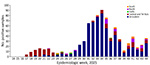
Figure 3. Positivity rates by epidemiologic week during April 1–October 31, 2025, from genomic and epidemiologic investigation into ongoing measles outbreak, Israel, 2025–2026. Weekly number of measles cases by district was confirmed…
To investigate positivity dynamics from an epidemiologic perspective, we evaluated the weekly ratios of positive and negative samples collected during April–October 2025 (epidemiologic weeks 14–44). When the outbreak began, the positivity rate was low (10%–20%), likely reflecting heightened awareness and broad testing of suspected cases with low pretest probability for measles. As transmission became established in specific districts during weeks 28–38, positivity increased to ≈60%, indicating outbreak persistence and targeted sampling (Appendix). During weeks 39–44, as the outbreak expanded to additional districts, the overall ratio decreased (Figure 3); we observed a similar trend through February 2026 (data not shown).
The ongoing measles outbreak in Israel threatens the country’s elimination status, defined by the World Health Organization as absence of endemic transmission for >12 months (https://iris.who.int/server/api/core/bitstreams/b0ee4708-ba01-4b40-9003-f6f1aba317da/content). This outbreak highlights the profound risks associated with declining vaccination coverage. Genomic sequencing of targeted measles samples indicated that a single importation event was most likely the primary driver of the outbreak. Phylogenetic analysis showed 3 validated distinct importation events from Russia, Vietnam, and Belgium; outcomes differed drastically based on local immunity. The main Belgium-linked cluster strain, detected in April 2025, likely sparked an extensive national outbreak. The second documented importation case from Belgium might have contributed to the main transmission cluster. The epidemiologic investigation indicated that this case-patient had many contacts and resided in an area experiencing a substantial outbreak. However, the case was detected 2 months after the Belgium index case, so it likely had little impact on outbreak dynamics. Furthermore, its shared mutations with the April 2025 Belgium case suggest a common source.
Additional undetected single cases might exist because of underreporting. However, our strict criteria and direct contact to Ministry of Health epidemiologic data enabled systematic assessment of each focal point, so underreporting is unlikely to have substantially affected the main phylogenetic findings. Positivity rates rose from 10%–20% during early broad testing to 60% during weeks 28–38, as diagnostics shifted to targeted surveillance during outbreak spread.
In summary, we integrated epidemiologic investigations with molecular surveillance, demonstrating that a single case can spark extensive measles transmission. Our findings highlight the critical role of molecular surveillance in measles outbreak management.
Dr. Bucris is the head of the Measles and Rubella national center with Central Virology Laboratory, Public Health Services, Ministry of Health and Sheba Medical Center, Ramat-Gan, Israel. Her research interest is vaccine-preventable viral diseases.
Members of the National Measles Working Group who contributed to providing clinical samples and collecting relevant clinical information: Haim Ben-Zvi (Beilinson Hospital, Petah Tikva, Israel); Yehudit Shindler (Mayanei HaYeshua Medical Center, Beni Brak, Israel); Ola Salach (Carmel Medical Center, Haifa, Israel); Hephzibah Ivgi (Shaare Zedek Medical Center, Jerusalem, Israel); Nadav Sorek (Assuta University Hospital, Ashdod, Israel); Danielle Keidar-Friedman (Assuta University Hospital, Ashdod, Israel); Margalit Zosev (Kaplan Medical Center, Rehovot, Israel); Merav Shtrauss (Emek Medical Center, Migdal HaEmek, Israel); Hila Ben-Amram (Ziv Medical Center, Zefat, Israel); Mona Shehadeh (Galilee Medical Center, Nahariya, Israel); Olga Bunder (Shamir Medical Center, Be’er Ya’akov, Israel); Dana Wolf, Mila Rivkin, and Esther Oiknine-Djian (Hadassah Medical Center, Jerusalem); Ayelet Naus (Soroka University Medical Center, Beer Sheba, Israel); Orna Shwartz (Wolfson, Israel); Moran Szwarcwort (Rambam Health Care Campus, Haifa); Maya Azarad (Tzafon Medical Center, Ramat Poriya, Israel); Ayman Fadila (Meir Medical Center, Kfar Saba, Israel).