



Disclaimer: Early release articles are not considered as final versions. Any changes will be reflected in the online version in the month the article is officially released.
To the Editor: We read with interest but also concern the article by Long et al. (1) describing putative doxycycline resistance–associated variants of the Treponema pallidum ribosomal RNA 16S gene. Determining if T. pallidum can become resistant to doxycycline is urgent, given its use for both prevention (i.e., doxy-PEP) and treatment of syphilis, especially amid ongoing shortages of benzathine penicillin G.
Figure
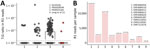
Figure. Ratio of G966T to wild-type G alleles among R1 reads of Treponema pallidum. We downloaded raw reads from the European Nucleotide Archive (BioProjects PRJEB28546 and PRJEB33181), which were…
As the groups that generated most of the sequencing data reanalyzed in Long et al. (1), our analyses were unable to replicate the primary finding of a heterozygous G966T 16S mutation (Escherichia coli numbering) in 9 samples. Using standard pathogen genomics methods (Figure), we did not find the variant in any reanalyzed sample at an allele frequency exceeding background technical noise.
Of note, >98% of publicly available T. pallidum genomes were generated from clinical specimens by metagenomic sequencing using hybrid capture probes. That method retains conserved non–T. pallidum DNA, such as ribosomal operons from other bacteria, in the sample (2,3), and can introduce errors when merging fragmented DNA reads into consensus sequences. Such artifacts may be incorporated into consensus T. pallidum genomes available from public resources such as pubMLST (https://pubmlst.org) or GenBank and misinterpreted as real mutations. Although Long et al. (1) reported filtering for reads arising from Treponema, we and others have shown the necessity of more stringent methods, such as competitive mapping versus related ribosomal sequences (2) or requiring near-identity to known T. pallidum rRNA sequences (4), to avoid inadvertent reporting errors.
The development of doxycycline resistance by T. pallidum could have devastating consequences for the control of syphilis and is being closely monitored by clinicians and scientists. We are encouraged by increasing genomic surveillance of T. pallidum, providing a mechanism for early detection of the emergence of resistance-associated variants.

Author affiliation: Wellcome Sanger Institute, Hinxton, UK (M.A. Beale); London School of Hygiene and Tropical Medicine, London, UK (M. Marks); University of California San Francisco, San Francisco, California, USA (A. Luetkemeyer); University of Washington, Seattle, Washington, USA (C. Celum, M.R. Golden, L. Giacani, N.A.P. Lieberman)