





Dr. Elizabeth ‘Lizzie’ Clarke during a birding session, one of her favorite pastimes. Clarke, a virologist who studied hantaviruses during her doctoral work at UNM, discussed the topic during an Oct. 15, 2026, presentation at the Pajarito Environmental Education Center in Los Alamos. Courtesy photo
By MARK A. MACINNES, Los Alamos Daily Post
El Niños bring Ecological Disruption
In the spring of 1993, the vegetation in the four-corners region of New Mexico was lush resulting from heavy rains of the recent fall-winter El Niño season. El Niño Christmastime Ocean warming cycle was named by Peruvian fishermen for the Christ child. However, El Niños were far from a gift. Along with ecological disruptions (collapsing cold water fish stocks in Peru, and lush vegetation in the Americas) there came a less noticed explosion in the four corners population of a shy western Deer Mouse (species P. Maniculatus).
On May 14, 1993, a 19-year-old Navajo athlete from Crownpoint fell sick with the sudden onset pneumonia but soon died in a hospital. Tragically, his young fiancée had also died of a similar illness just five days earlier. These events raised widespread alarm in the Indian Health Service and New Mexico State Health authorities. By late June, medical investigators had identified about thirty suspected similar cases and ten unknown deaths across the Four Corners region.
Dr. Elizabeth “Lizzie” Clarke, a virologist who studied hantaviruses during her doctoral work at UNM, recounted this medical detective story during an Oct. 15, 2026, presentation at the Pajarito Environmental Education Center (PEEC) in Los Alamos.
Urgent Hunt for an Elusive Pathogen
What was killing previously healthy young adults? The answer emerged through a remarkable collaboration among the Indian Health Service, University of New Mexico researchers and the Centers for Disease Control and Prevention. Within six months, they identified a previously unknown North American hantavirus, called ‘Sin Nombre,’ which is Spanish for “no name” hantavirus to avoid stigmatizing the affected communities. The western Deer Mouse was identified as its mammalian host (vector).
An ecological warning remembered as episodes of ecological ‘disharmony.’
Navajo elders recalled earlier periods when abundant rains brought flourishing vegetation, surging rodent populations and mysterious illnesses. As Dr. Clarke reflected, “The Navajo Nation and the Navajo people have been living alongside hantaviruses for much longer,” noting that traditional precautions against contact with rodent-contaminated belongings long preceded the virus’s identification by Western medicine.
A shy mouse with a dangerous passenger
The western deer mouse, unlike the more uniformly gray-brown house mouse, typically has a pale underside and a sharply striped two-toned tail. Its shy behavior favors undisturbed places around homes, like sheds and seldom visited out buildings. Infected deer mice can carry the Sin Nombre virus without appearing sick but pass it among nesting communal mice.
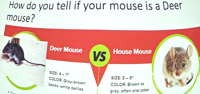
Deer Mouse compared to the house mouse. The deer mouse is larger with a pronounced white stripe on its underside and tail. Courtesy/Dr. Elizabeth Clarke
Yet a major puzzle remains. “We knew that the deer mouse was everywhere [in the southwest], and now we know that the virus is found in those places too,” Clarke said. Yet researchers still cannot fully explain the geographical concentration of human illness in the four corners region.
Prevention and the race to treatment
People become infected when they inhale particles from disturbed rodent urine, droppings, or nesting material. Early symptoms, fever, muscle aches and sometimes stomach upset may develop one to eight weeks after exposure. In severe cases, breathing can deteriorate astonishingly fast. As Clarke described it, “people have mild symptoms in the morning and [can be] in full respiratory failure by the end of the day.”
There is no approved vaccine or specific cure for Sin Nombre infection. Hospital treatment focuses on supporting failing organs; in critical cases, early use of a heart-lung machine that oxygenates blood outside the body can temporarily substitute for the lungs while a patient recovers.
For homeowners, the CDC advises never sweeping or vacuuming dry rodent waste. Instead, ventilate enclosed spaces if possible, and thoroughly soak contaminated material with disinfectant 10 % diluted bleach before removing waste. Extensive contamination or poor ventilation call for additional precautions and require professional cleanup.
A surprising echo from Paraguay
Clarke ended her talk with an episode affecting her spouse. In 2025, her husband led a summer long UNM paleontology expedition into remote areas of Paraguay. After the crew returned, one participant was hospitalized in Albuquerque with severe respiratory illness; another had a milder infection. Investigators cultured a previously unrecognized hantavirus; but Sin Nombre was not responsible for the illnesses. The new hantavirus strain became known informally as the ‘bone virus,’ or ‘Kangue’ strain, derived from the indigenous Paraguayan language. More than three decades after the Four Corners outbreak, an expedition searching for dinosaur bones revealed another medical mystery, rapidly and successfully solved for the patients in Albuquerque medical centers.
The El Niño of 2026-27
Now, 33 years later, a strengthening El Niño is again bringing unusually heavy rainfall to the Four Corners region, including widespread current October flooding. Whether next spring will produce another surge in deer mouse populations and potentially increase hantavirus exposures remain open scientific and medical questions.