



Disclaimer: Early release articles are not considered as final versions. Any changes will be reflected in the online version in the month the article is officially released.
Author affiliation: Institute of Biological Science, Federal University of Amazonas, Manaus, Brazil (J. de Melo Silva, G.S. Pontes); Leônidas and Maria Deane Institute–ILMD/Fiocruz Amazônia, Manaus (E.M.V. Mourão); Foundation of Hematology and Hemotherapy of Amazonas, Manaus (E.M. Santos); National Institute of Amazonian Research, Manaus (L.S. Mineiro, P.H.R. de Souza, L.C. de Oliveira, J. da Silva Batista, G.M. Guimarães Marques, G.S. Pontes); Faculty of Medicine, Imperial College London, London, UK (C.R. de Oliveira, G.P. Taylor); National Centre for Human Retrovirology, St. Mary’s Hospital, Imperial College Healthcare NHS Trust, London (G.P. Taylor); Federal University of Pará, Belém, Brazil (A.C.R. Vallinoto)
Epidemiologic surveillance is essential for defining the burden, geographic distribution, and transmission patterns of human T-lymphotropic viruses (HTLVs) 1 and 2 (HTLV-1/2), particularly in underserved settings such as the Brazilian Amazon. Although Brazil is estimated to harbor the largest absolute number of HTLV-1 infections worldwide, data from urban Amazonian populations remain scarce (1,2). In this context, molecular surveillance is also critical because HTLV genetic diversity is geographically structured, could have clinical relevance, and helps refine understanding of lineage distribution and viral dissemination (3). We therefore investigated HTLV-1/2 infection in the metropolitan region of Manaus in the Amazonas state of Brazil and performed phylogenetic and phylogeographic analyses.
During May 2021–November 2023, we conducted a cross-sectional study of 1,397 residents of metropolitan Manaus recruited by convenience sampling across different city zones at universities, community centers, polyclinics, and primary healthcare units. Eligible participants were Manaus residents >7 years of age who voluntarily agreed to participate and provided written informed consent; for minors, we obtained parental or guardian consent and assent when applicable. We screened plasma samples for HTLV-1/2 antibodies by ELISA and confirmed seroreactive samples by Western blot or line immunoassay; indeterminate samples underwent molecular testing. We collected sociodemographic and behavioral data through a standardized questionnaire.
We amplified the 5′ long terminal repeat (LTR) region of HTLV-1 (579 bp) and HTLV-2 (788 bp) by nested PCR and sequenced the amplicons by Sanger sequencing. We inferred phylogenetic relationships by maximum-likelihood analysis in MEGA12 (https://www.megasoftware.net) using the Kimura 2-parameter model with 1,000 bootstrap replicates and a geographically diverse panel of HTLV-1 and HTLV-2 reference sequences retrieved from GenBank from a previously assembled dataset. We deposited sequences generated in this study into GenBank (accession nos. PV647910 for sequence WDM1168_BrMao, PV647909 for sequence WQC1199_BrMao, PV647908 for sequence SSS850_BrMao, and PV742404 for sequence JDC1001_BrMao). To investigate the timing and geographic history of HTLV-1 lineages, we performed Bayesian time-scaled phylogenetic and discrete phylogeographic analyses in BEAST X version 10.5 (https://beast.community).
Figure 1
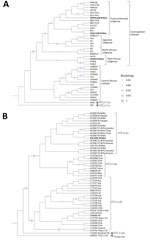
Figure 1. Phylogenetic tree of HTLV isolates in study of emergence of West African HTLV-1aC subgroup, Brazilian Amazon. A) HTLV-1 sequences obtained in this study (bold text) were analyzed with 38 reference…
Overall HTLV-1/2 seroprevalence was 0.3% (95% CI 0.11%–0.73%; 4/1,397 participants), comprising 3 HTLV-1 and 1 HTLV-2 infections. All seropositive participants were >40 years of age and shared a profile of socioeconomic vulnerability: 75% were female, earned no more than minimum wage, had only elementary education, lacked marital partnerships, and relied on government assistance (Appendix). Phylogenetic analysis classified sequence SSS850_BrMao as HTLV-1aC, the West African subgroup, providing evidence of this lineage in the Brazilian Amazon (Figure 1, panel A). The remaining isolates were HTLV-1aA (WDM1168_BrMao and WQC1199_BrMao) and HTLV-2c (JDC1001_BrMao), indicating co-circulation of distinct HTLV lineages in this population (Figure 1).
Figure 2
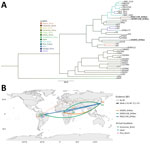
Figure 2. Time-scaled phylogeny and discrete phylogeographic diffusion of HTLV-1 lineages in study of emergence of West African HTLV-1aC subgroup, Brazilian Amazon. A) Time-calibrated maximum clade credibility tree inferred in BEAST version…
After we identified the HTLV-1aC lineage, we performed Bayesian time-scaled phylogenetic and discrete phylogeographic analyses to infer its introduction and evolutionary history (Figure 2). Our results demonstrate that strain SSS850_BrMao clusters robustly within the HTLV-1aC clade, supporting its introduction into Amazonas around 2015 without evidence of intermediate dispersal through Pará. In contrast, 2 HTLV-1aA sequences clustered with reference sequences from Japan, indicating a separate introduction into northern Brazil via Pará (≈1971) followed by spread to Amazonas (≈1996). Together, those findings reveal >2 subtype-stratified introductions and identify HTLV-1aC as an epidemiologically relevant lineage in the region. However, because the phylogeographic inferences were based on a ≈579-bp 5′ LTR region fragment, they should be interpreted cautiously.
We observed a HTLV-1/2 prevalence in metropolitan Manaus, lower than estimates from other regions of Brazil, including Salvador and Mato Grosso do Sul (4,5). However, comparisons should be made with caution because sampling strategies and population composition differ across studies. Beyond prevalence, the key finding was detection of HTLV-1aC. Although this subgroup has previously been reported in Brazil by restriction fragment length polymorphism analysis (6), our study provides phylogenetically supported evidence of HTLV-1aC’s occurrence in the country and places it in phylogeographic context. This result broadens the known distribution of HTLV-1aC and suggests that viral diversity in northern Brazil may be greater than previously recognized, despite evidence that HTLV-1aA predominates nationwide (7,8). Phylogeographic analyses supported >2 subgroup-specific introductions into the region, highlighting HTLV-1aC as an epidemiologically relevant lineage. We also identified HTLV-2c in an urban resident, reinforcing evidence that this subtype is not restricted to Indigenous populations and might circulate across multiple epidemiologic settings in northern Brazil (9,10).
The first limitation of our study is that we used convenience sampling at multiple sites, rather than a population-based design. Therefore, the sample might not fully represent the city’s general population. The small number of positive participants precluded robust inference on risk factors or transmission routes. Phylogeographic reconstruction was further constrained by use of a short 5′ LTR fragment from a slowly evolving virus and by uneven regional sequence availability, reducing temporal and geographic resolution.
Despite those limitations, detection of HTLV-1aC in Manaus has surveillance relevance because rare lineages might remain unnoticed in settings with limited molecular monitoring. Broader epidemiologic surveillance combined with longer genomic regions and regionally representative sampling will be essential to refine lineage dispersion patterns, strengthen transmission hypotheses, and support HTLV prevention, diagnosis, and care policies tailored to the Brazilian Amazon.
Dr. de Melo Silva is a biomedical scientist with the Institute of Biological Science, Federal University of Amazonas, Manaus, Brazil. His research interest is the epidemiology of viral infections, particularly emerging viruses, in the Brazilian Amazon.
We thank the Amazonas State Research Support Foundation, the Coordination for the Improvement of Higher Education Personnel (CAPES), the National Council for Scientific and Technological Development (CNPq), the Pan American Health Organization, the World Health Organization, the Ministry of Health, and the Ministry of Science, Technology and Innovation for their support of this project. We also thank SEMSA (Municipal Health Department) and SES-AM (Amazonas State Health Department) for help with participant recruitment. In addition, we are grateful to the Federal University of Amazonas, as well as the staff of the laboratory of Virology and Immunology-INPA, for their valuable assistance, particularly with sample collection.
Ethical approval was granted by the National Commission for Ethics Research and the INPA Human Research Ethics Committee on October 21, 2020 (CAAE: 39320120.2.3000.0106).
The data that support the findings of this study are available from the corresponding author upon reasonable request.
This work was supported by the Amazonas State Research Support Foundation, the Coordination for the Improvement of Higher Education Personnel Brazil (grant nos. 88881.933595/2024-01 and PROCAD AMAZONIA 88881.200581/201801), and the National Council for Scientific and Technological Development (grant nos. 401569/2023-3 and 302935/2021-5).
J.M.S. conceived and designed the study, collected blood samples, performed laboratory assays, curated and analyzed data, and prepared the original draft. G.S.P. conceived and designed the study, supervised all activities, secured funding, managed the project, interpreted data, and contributed to writing and critical revision of the manuscript. A.C.R.V. secured funding, supported study oversight and data interpretation, and contributed to writing and revision of the manuscript. C.R.O. and G.P.T. contributed to the study design and data interpretation and also participated in writing and critical revision of the manuscript. J.S.B. and G.M.G.M. performed sample purification and HTLV-1/2 LTR amplicon sequencing, curated sequencing data, and supported laboratory quality control. E.M.S., E.M.V.M., L.S.M., P.H.R.S., and L.C.O. collected blood samples and field data and assisted with data curation. All authors reviewed and approved the final version of the manuscript.