



Disclaimer: Early release articles are not considered as final versions. Any changes will be reflected in the online version in the month the article is officially released.
Author affiliation: Universidade Federal dos Vales do Jequitinhonha e Mucuri, Diamantina, Brazil (A.S.N. Ferreira, D.B. de Oliveira, M.A.A. Schetino, M.F.A. Araújo, T.J. Silva, T.G.M. Silva, E. Rocha-Vieira); Instituto Federal do Norte de Minas Gerais, Laboratory of Insect Behavior, Salinas, Brazil (T.J. Teixeira, A.B. de Araújo, R.S. Oliveira, F.V.S. de Abreu); Universidade Estadual de Montes Claros, Montes Claros, Brazil (C.H. de Oliveira, M.E.G. dos Santos); Universidade Federal de Minas Gerais, Belo Horizonte, Brazil (P.A.A. Souza); Universidade Federal do Rio Grande do Sul, Porto Alegre, Brazil (F.S. Campos, P.M. Roehe)
In Brazil, Oropouche virus (OROV; Orthobunyavirus oropoucheense), Mayaro virus (MAYV; Alphavirus Mayaro), West Nile virus (WNV; Orthoflavivirus nilense), and Saint Louis encephalitis virus (SLEV; Orthoflavivirus louisense)have been detected beyond areas in which they were traditionally known to circulate, and evidence suggests silent circulation of some of them in several regions (1–3). Those arboviruses are transmitted by mosquitoes and other hematophagous vectors and are maintained in transmission cycles involving vertebrate hosts (4). Changes in vector distribution, human mobility, and environmental conditions might favor their spread into new areas (5).
The state of Minas Gerais in southeastern Brazil has diverse climatic and ecologic conditions that might favor arbovirus transmission. In 2024, the state declared a public health emergency amid increased arboviral activity, including the first reported OROV infection (6). Serologicand molecular evidence also suggests circulation of WNV and SLEV in equids in the state (7,8), despite the absence of confirmed human SLEV cases.
The circulation of OROV, MAYV, WNV, and SLEV in northern and northeastern Minas Gerais remains poorly understood. We investigated those viruses in mosquitoes, nonhuman primates, and patients with acute febrile illness of unknown origin using an integrated One Health approach. Human samples were collected during 2023–2025, mosquito samples during 2019–2024, and nonhuman primate samples during 2019–2023.
Figure
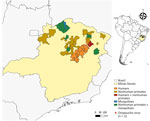
Figure. Municipalities of Minas Gerais State, Brazil, where samples were collected in study of molecular surveillance for Oropouche, Mayaro, West Nile, and Saint Louis encephalitis viruses, Brazil, 2019–2025. Sampling sites covered…
Using a One Health approach, we conducted a cross-sectional study of human, mosquito, and nonhuman primate samples collected from 51 municipalities in northern and northeastern Minas Gerais, Brazil, to investigate the circulation of OROV, MAYV, WNV, and SLEV (Figure; Appendix Table 1). The study was approved by the Universidade Federal dos Vales do Jequitinhonha e Mucuri institutional review board and the appropriate animal ethics and wildlife authorities.
We analyzed serum samples collected during February 2023–February 2025 from patients with acute febrile illness who sought care at hospitals and primary healthcare facilities. Human samples were obtained from 23 municipalities and submitted to a reference laboratory for diagnostic investigation. We selected 824 serum samples from 5,821 patients with signs and symptoms compatible with arbovirus infection and negative quantitative reverse transcription PCR (qRT-PCR) results for dengue virus, chikungunya virus, and Zika virus. Serum was collected within 5 days after symptom onset. Most of the 824 patients were 20–59 years of age, and the most frequently reported symptoms were headache, myalgia, and fever (Table 1). Most samples were collected in 2024 (725/824 [88.0%]) and originated from Diamantina (305/824 [37.0%]) and Capelinha (135/824 [16.4%]) (Appendix Figure).
We also tested 3,484 mosquitoes collected in urban and sylvatic areas of 7 municipalities during 2019–2024. We identified mosquitoes to species whenever possible and grouped them into pools according to species, collection site, and sex. We processed male and female mosquitoes in separate pools and processed engorged females separately from nonengorged ones. The most abundant species collected were Psorophora albipes (1,011 [29.0%]), Culex quinquefasciatus (459 [13.2%]), and Aedes albopictus (384 [11.0%]) mosquitoes (Table 2). Epidemiologically relevant mosquito groups were represented in the collection, including Culex spp. (647 [18.6%]) and Haemagogus spp. (28 [0.8%]) mosquitoes (Table 2).
We also analyzed samples from 113 nonhuman primates collected during 2019–2023 in 28 municipalities as part of the yellow fever surveillance program. Samples consisted of whole blood, serum, liver, or spleen from Alouatta caraya monkeys; Callithrix penicillata, C. geoffroyi, and C. kuhlii marmosets; and Callicebus sp. monkeys (Table 3). C. penicillata marmosets accounted for 83.3% of the sampled animals.
All mosquito and nonhuman primate samples were also previously screened by multiplex qRT-PCR for dengue virus, chikungunya virus, and Zika virus and were negative for all 3 viruses. We subsequently tested extracted RNA by duplex qRT-PCR for simultaneous detection of OROV/MAYV and WNV/SLEV using previously validated protocols (9–11). For human samples, we used an internal control targeting the human RNase P gene to assess nucleic acid extraction and amplification (12). For mosquito and nonhuman primate samples, we measured RNA concentration by NanoDrop spectrophotometry (Thermo Fisher Scientific, https://www.thermofisher.com) before molecular testing. All qRT-PCRs included positive and negative controls. We considered samples with a cycle threshold value Appendix).
Among the 824 patients tested, we detected OROV RNA in 1 patient sampled in January 2025 (cycle threshold 21.29). Clinical symptoms were fever, headache, and chills. The patient was a resident of Aracruz, Espírito Santo state, where circulation of Oropouche fever had been documented. At the time of illness, the patient was visiting family in the study area. On the basis of the epidemiologic investigation, we classified the infection as imported into Minas Gerais. No other human samples were positive for OROV, MAYV, WNV, or SLEV. All 314 mosquito pools tested negative for OROV, MAYV, WNV, and SLEV, corresponding to a minimum infection rate of 0 per 1,000 mosquitoes tested for each virus.
Our One Health investigation found no molecular evidence of active local circulation of OROV, MAYV, WNV, or SLEV in northern and northeastern Minas Gerais during the study period; we found no evidence of viral infection in humans or wild hosts. We detected 1 OROV infection, which we classified as imported on the basis of the epidemiologic investigation. Those findings provide a baseline for monitoring emerging arboviruses in the region but do not exclude sporadic or low-level circulation.
Most OROV cases reported in Minas Gerais have occurred in Atlantic Forest areas (13), whereas most samples in our study originated from the Cerrado. Culicoides paraensis midges, the primary vector for OROV transmission (4), were not represented in our collections. That species’ distribution is influenced by temperature and precipitation patterns, and ecologic models suggest lower environmental suitability for the vector in tropical savanna and seasonally dry environments than in humid tropical areas (14). Those ecologic differences might have influenced OROV transmission and detection in our study area. However, the detection of an imported OROV case highlights the potential for human mobility to introduce the virus into areas without documented local transmission.
In addition, we detected no MAYV, WNV, or SLEV RNA in the analyzed samples. The small number of Haemagogus mosquitoes collected limited our ability to assess MAYV circulation. For WNV and SLEV, previous studies in Brazil have identified serologic evidence of circulation despite infrequent direct viral detection (8,15), suggesting that molecular surveillance alone might underestimate exposure.
The first limitation of our study is that, because arbovirus viremia is generally short-lived, molecular testing might fail to detect infections when samples are collected outside the viremic period. In addition, sampling periods differed among humans, mosquitoes, and nonhuman primates, precluding direct temporal comparisons across the 3 surveillance components. Human sampling was also uneven across the 23 municipalities; >50% of samples originated from Diamantina and Capelinha. That pattern might partly reflect a higher burden of acute febrile illness or greater healthcare utilization in those municipalities. However, because sampling was not population-based, the uneven distribution might have limited spatial representativeness and reduced the likelihood of detecting viral circulation elsewhere.
Except for the imported OROV infection identified, the absence of viral RNA in the samples analyzed should not be interpreted as evidence that those viruses do not circulate in the region. Integrating molecular testing with serologic surveys and other complementary approaches could provide a more comprehensive assessment by identifying previous exposure and low-level transmission. Continuing to integrate human, animal, and entomological surveillance will be essential for detecting changes in arbovirus distribution and distinguishing imported infections from local transmission.
Ms. dos Santos Nunes Ferreira is a PhD candidate at the Universidade Federal dos Vales do Jequitinhonha e Mucuri, Diamantina, Minas Gerais, Brazil. Her research focuses on molecular biology and virology, with an emphasis on arboviruses and emerging infectious diseases.
We acknowledge the invaluable contribution of our colleague and coauthor, Paulo Michel Roehe, who passed away during the submission of this manuscript. His contributions were fundamental to this work.
This study was supported by the Secretaria de Estado de Saúde de Minas Gerais, the Secretaria Municipal de Saúde de Salinas, the Secretaria Municipal de Saúde de Diamantina, the Centro Colaborador de Entomologia, and the Centro Colaborador UFVJM-Diamantina. Funding was provided by the Secretaria de Estado de Saúde de Minas Gerais (agreement no. 007/2022), Fundação de Amparo à Pesquisa do Estado de Minas Gerais (grant nos. RED-00234-23, APQ-01403-21, APQ-02363-22, and APQ-04955-23), Conselho Nacional de Desenvolvimento Científico e Tecnológico (grant nos. 443215/2019-7 and 401933/2020-2), and Instituto Federal do Norte de Minas Gerais (internal call for proposals no. 21/2020). C.H.O. is a doctoral fellow supported by Fundação de Amparo à Pesquisa do Estado de Minas Gerais. F.V.S.A. is supported by an Instituto Serrapilheira grant.
The authors used generative artificial intelligence (ChatGPT, https://chatgpt.com) to improve language clarity. The authors are fully responsible for the content of this manuscript.