



After nearly two years of relentless attacks on science and public health, a growing number of infectious disease professionals are speaking out against anti-vaccine policies and cuts to medical research.
“All physicians have an obligation to stand up for the needs of our patients,” Haley Pritchard, MD, an associate professor of clinical medicine at the Indiana University School of Medicine, told CIDRAP News.
Doctors “are increasingly not just willing, but eager, to advocate for healthcare and public health issues in response to the attacks on public health, vaccines, scientific integrity, research funding, and equitable, accessible healthcare,” she said.
Pritchard was one of several doctors who led advocacy training sessions at IDWeek, a conference about infectious diseases that concluded on October 24. Pritchard noted that people with HIV and their healthcare teams have been politically engaged for many years.
“We understand more than ever how political events and decisions affect our day-to-day lives and those of our patients,” said Pritchard, who spoke at a session about advocating for patients with state policy makers.
Encouraging health professionals to speak out
Some speakers at IDWeek urged their audiences to vote in the midterm elections next week.
At the conference’s opening session, Georges Benjamin, MD, the CEO of the American Public Health Association, noted that the conference was taking place just over a mile away from the White House.
“We have work to do that requires that you speak up and not tolerate the nonsense from the folks living down in public housing down the street there,” Benjamin said.
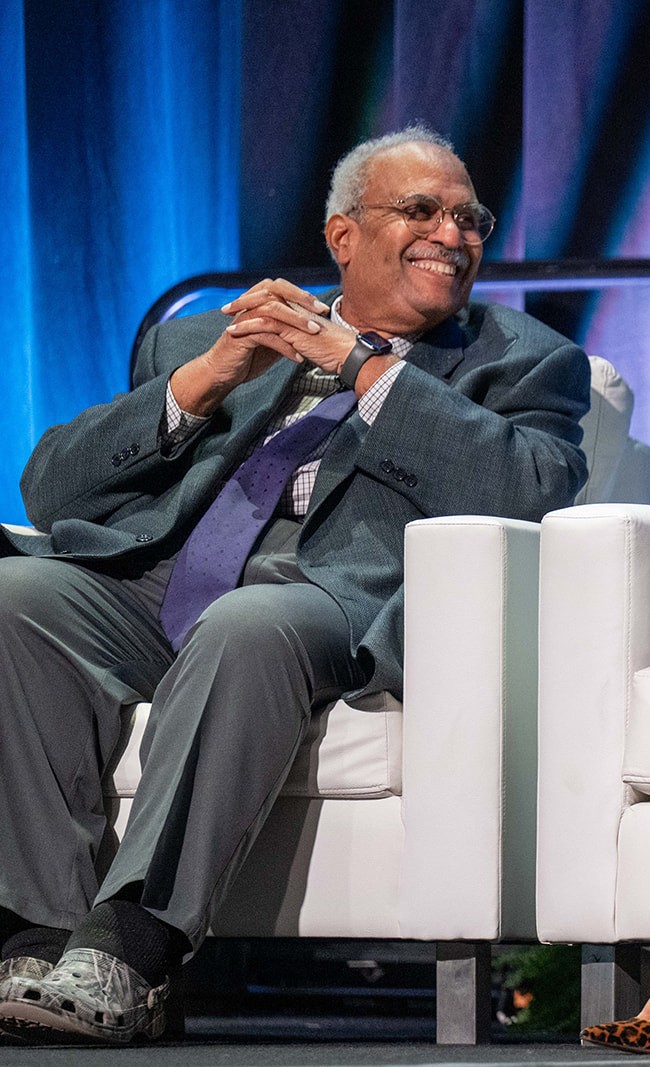
Kelli Price Photography
As always, the IDWeek schedule included hundreds of presentations and workshops, nearly all of which focused on research related to influenza, antimicrobial resistance, and other important infectious disease and medical topics. IDWeek typically includes a handful of sessions about advocacy.
But for the first time, IDWeek also offered a four-hour “advocacy lab,” a hands-on workshop that trained healthcare providers how to advocate for infectious disease research funding and treatment on Capitol Hill.
“People had been asking us for it for a few years,” said Amanda Jezek, senior vice president for public policy and government relations at the Infectious Diseases Society of America (IDSA).
Participants at the workshop played the roles of advocates and lawmakers, which helped them hone their pitches. Instructors helped participants learn to tell patient stories, which can be more powerful than presenting pages of statistics, Jezek said.
Other IDWeek sessions included “Opportunities in Vaccine Advocacy and Communication”; “Your Voice, Your Patients, Your Community: ID and HIV Advocacy in an Election Year”; and “Reading the Hill: What the 2026 Elections Mean” for infectious disease specialists.
Several of these sessions allowed participants to earn continuing medical education credits.

Kelli Price Photography
About 100 people at the conference joined a member advocacy program run by the IDSA and HIV Medicine Association (HIVMA), two of the medication organizations that sponsor IDWeek, Jezek said.
Although doctors are often reluctant to get politically involved, Jezek noted, many are motivated by changes to federal vaccine recommendations, the cancelation of billions of dollars in research grants, as well as hundreds of billions of dollars in cuts to the Medicaid program.
“There’s more interest in advocacy than ever before,” shesaid.
Training doctors for advocacy
At least one medical school is teaching young infectious disease doctors how to talk to policy makers.
The curriculum for infectious disease fellows at the Hospital of the University of Pennsylvania now includes a six-week health advocacy course, according to a study presented at IDWeek by M. Elle Saine, MD, PhD, a fellow at the hospital. The course was taught by guest lecturers, including physicians within the infectious diseases department, health advocates, health system leaders, and a former director of the Centers for Disease Control and Prevention, Saine said.
Science is a powerful thing to have on our side, so we shouldn’t be afraid to stand up for it.
After completing the class, the 10 people who took the course—six fellows, an advanced practice practitioners and three faculty—
felt more confident in their ability to engage in grassroots advocacy, call or meet with legislators in person, and teach health topics to non-medical audiences, among other skills.
In the study abstract, Saine and her colleagues wrote that, “to our knowledge, this is the first advocacy curriculum designed specifically for ID fellows and integrated into fellowship training.”

Kelli Price Photography
The costs of activism
About 100 people attended a rally in protest of cuts to HIV prevention and treatment services at the conference. About two dozen attended a protest in a Washington, DC, park called “911 Rally for Health and Science.”
“Doctors are speaking out because we see that the field of infectious diseases is under attack,” said Arya Zandvakili, MD, PhD, an infectious disease physician in Cincinnati, Ohio, who attended IDWeek and the park protest. “Vaccine-preventable illnesses are surging because political leaders are deliberately undermining public trust in routine immunizations for their own personal gain.”

Kelli Price Photography
Yet speaking out carries risks.
Peter Hotez, MD, PhD, has battled anti-science misinformation for years through books, social media posts, and frequent television appearances. That’s made him a target of anti-vaccine activists, who attack him on social media and send threatening emails. In 2023, after Elon Musk joined online attacks against him, two critics showed up at Hotez’s home.
Sometimes, the pressure gets to him.
“I go through pretty high highs and low lows, said Hotez, co-director of the Texas Children’s Hospital Center for Vaccine Development and co-developer of two low-cost, patent-free COVID vaccines designed to for use in the developing world.
“During the day, I’m talking to people like you,” Hotez told a CIDRAP News reporter during IDWeek. “But at night, it messes with your head.”
Paul Offit, MD, director of the Vaccine Education Center at the Children’s Hospital of Philadelphia, also has received death threats because of his pro-vaccine advocacy.
Yet Offit, who spoke at IDWeek about rotavirus vaccines, remains one of the most vocal critics of Health and Human Services Secretary Robert F. Kennedy Jr., who frequently casts doubt on the efficacy of vaccines and promotes untested remedies.
Offit spoke at the doctor’s rally in a public park last week, stating, “Science is a powerful thing to have on our side, so we shouldn’t be afraid to stand up for it.”