



Disclaimer: Early release articles are not considered as final versions. Any changes will be reflected in the online version in the month the article is officially released.
Author affiliation: Pedro Kourí Tropical Medicine Institute, Havana, Cuba (A. Martínez-Rodríguez, E. Cruz Rodríguez, A. González Díaz, M. Álvarez Vera, N. Molina Águila, W. Baldoquin Rodríguez, D. Velázquez Rodríguez, M.E. Toledo Romani, V. Kourí Cardellá, M.G. Guzmán); Ministry of Health, Havana (J.R. de Armas Fernández); Provincial Center of Hygiene, Epidemiology and Microbiology of Havana, Havana (M. García Carmenate)
Oropouche fever (OF) is an emerging arboviral disease caused by Oropouche virus (OROV), which is transmitted primarily by Culicoides paraensis biting midges (1). During 2024, OROV activity increased substantially across the Americas, including in countries in which no previous local transmission had been documented (2).
In Cuba, a passive arboviral surveillance system detects acute febrile illness through a network of polyclinics and hospitals (3). The country experiences frequent dengue outbreaks, which peak seasonally during May–November (4). Dengue IgM screening is performed in 30 regional laboratories. Confirmatory real-time PCR for OROV is centralized at the National Reference Laboratory of the Pedro Kourí Tropical Medicine Institute (NRL-IPK; Havana, Cuba) (3), where ongoing surveillance detects and monitors multiple arboviruses, including dengue, chikungunya, Zika, and Mayaro (3).
On May 27, 2024, the Ministry of Public Health reported an outbreak of OF in Cuba (5). The outbreak was detected in Santiago de Cuba and Cienfuegos Provinces, where acute febrile illness cases exceeded seasonal levels and results of dengue testing remained negative. The surveillance system generated an alert for a possible emerging pathogen (6). After OROV circulation was confirmed by real-time PCR at the NRL-IPK, testing was limited to a subset of suspected cases (rather than universal screening) because of reagent shortages and operational constraints. Within 3 months, the outbreak had spread nationwide, involving 109 municipalities across all 15 provinces (7). By the end of the year, a total of 24,259 suspected cases were identified through the national febrile surveillance system; 626 cases were confirmed as OF (8). In this article, we describe the epidemiologic behavior of the initial OF outbreak in Havana and examine its implications for surveillance in a dengue-endemic setting, given the city’s high population density, history of arboviral epidemics, and role as a national travel hub.
We conducted a descriptive outbreak investigation in Havana Province (population 2,122,057), which consists of 15 municipalities, including Cuba’s capital city, and accounts for ≈20% of the national population. The NRL-IPK Ethics Committee approved the investigation (approval no. CEI-IPK 54–24).
We analyzed data from febrile surveillance for June 1–September 7, 2024, a period that captures the onset and initial growth of the OF outbreak in Havana. We defined a suspected case as fever >38°C with headache and >1 additional symptom (myalgia, arthralgia, chills, low back pain, or photophobia), negative dengue IgM results, and residence in or travel to an area with confirmed OROV transmission or unusual febrile illness activity within the previous 2 weeks. A confirmed case required detectable OROV RNA by real-time PCR (9) (Appendix Table 1).
We collected demographic, clinical, and laboratory data from municipal databases and a standardized clinical–epidemiologic form developed by the NRL-IPK (Appendix Figure). We performed dengue IgM testing across the provincial laboratory network (3). OROV real-time PCR was performed at the NRL-IPK using a multiplex real-time protocol (10). We merged, verified, and cleaned data before analysis.
We calculated absolute and relative frequencies and incidence rates per 100,000 population using 2024 demographic projections from the National Bureau of Statistics and Information. Because selective sample referral precluded reliable municipality-specific incidence estimates, we present municipal-level data as frequencies only.
Figure
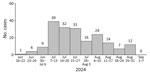
Figure. Epidemic curve of cases in Oropouche fever outbreak, Havana, Cuba, June 16–September 7, 2024 (N = 189). The first confirmed infection was identified on June 19.
During the study period, surveillance in Havana identified 21,744 suspected cases. Of the 549 samples tested by RT-PCR, 189 (34.4%) were positive for OROV. The earliest suspected case appeared on June 1, followed by the first confirmed OF case on June 19. Cases peaked at 39 during July 7–13 and stayed elevated over the next 2 weeks (32 cases and 31 cases), then declined to zero by early September (Figure). The overall incidence rate was 8.9/100,000 population.
OF cases appeared in 13 of 15 municipalities. Place of residence was known for 175 (92.6%) of 189 case-patients. La Lisa accounted for 94 (53.7%) of those cases. Cotorro reported no cases, and Regla submitted no samples for testing. Incidence peaked among adults 27–59 years of age (10.2/100,000 people) and was higher in female (9.4/100,000 population) than male (8.2/100,000 population) populations (Table). Three infants tested positive, including 2 neonates (8 days of age) who had no congenital anomalies.
Clinical data were available for 61/189 (32.3%) confirmed cases (Appendix Table 2). All patients had fever. The most frequent symptoms were headache (44/61 [72.1%]), malaise (36/61 [59.0%]), and myalgia (31/61 [50.8%]). Gastrointestinal symptoms consisted of anorexia (21/61 [34.4%]) and vomiting (20/61 [32.8%]). No cases were severe, and no deaths were reported.
During May–December 2024, Cuba reported 626 confirmed OF cases; 524 (83.7%) had occurred by September (8). The epidemic curve in Havana closely mirrored that national pattern: cases peaked during July 7–August 10 then declined in parallel with the rest of the country (8). That synchronized timing confirms that the local outbreak was an integral part of the nationwide epidemic.
The rapid spread of OROV across Cuba by mid-2024, months after its February introduction, suggests human mobility drove the outbreak. Previous estimates of 1.90 km/day dispersal and 70% long-distance viral spread align with this pattern, implicating commuting and interprovincial travel over vector dispersal alone (10).
C. paraensis midges were identified in Cuba during this outbreak (11). Cases clustered in western Havana municipalities (La Lisa, Playa, and Boyeros), areas historically prone to arboviral epidemics (11). That geographic concentration likely reflects local ecologic conditions that support vector establishment. Rising temperature, humidity, and rainfall during the study period (12) might have further amplified vector proliferation and transmission (13).
The first limitation of our study is that molecular testing was limited to a subset of suspected cases, which likely underestimated the true disease burden and introduced selection bias. Because sample referral was driven by operational logistics rather than random selection, we could not calculate reliable municipality-specific incidence rates or perform a comprehensive geographic risk assessment. In addition, mild or self-limiting infections in persons who did not seek medical care or infections that did not meet the criteria for testing were likely missed. The use of a dengue-adapted clinical–epidemiologic form might have missed OF-specific clinical features, and the mandatory negative dengue IgM result for case definition might have systematically excluded co-infections. Despite those constraints, our investigation provides useful evidence on urban OROV transmission and the resilience of integrated surveillance in resource-limited settings.
Detection of OROV in 3 infants, including 2 neonates, raises concerns about potential vertical transmission, as recently highlighted in Brazil (14). However, the absence of congenital anomalies or severe disease in our cases limits definitive conclusions about teratogenicity.
This investigation documents the rapid establishment of OROV transmission in an urban population and the national capacity to detect emerging pathogens in a dengue-endemic setting. Arboviral cocirculation strained both surveillance and clinical systems. First, event-based surveillance should complement formal reporting to absorb sudden surges of nonspecific febrile illness and rising healthcare demand. Second, clinicians faced overlapping symptoms and delayed laboratory confirmation, highlighting the need for faster testing and clearer clinical guidance. Third, our infant findings underscore the urgent need to integrate congenital and perinatal surveillance into existing maternal–child health programs. Strengthening laboratory capacity, expanding perinatal monitoring, and improving event-based detection are essential to mitigate future arboviral outbreaks.
Dr. Martínez-Rodríguez is a professor and researcher at the Department of Epidemiological Surveillance and Research at Pedro Kourí Tropical Medicine Institute. Her main research interests are epidemiological studies on tuberculosis, arboviruses, and pharmacoepidemiological studies.