



Disclaimer: Early release articles are not considered as final versions. Any changes will be reflected in the online version in the month the article is officially released.
Author affiliation: University of Minnesota Medical School, Minneapolis, Minnesota, USA (M. Lindstrom, J.N. Sembrano, D.B.G. Tai); University of Minnesota School of Public Health, Minneapolis (B.W. Langworthy)
Surgical site infection (SSI) after spinal surgery occurs in ≈2% of procedures and is associated with substantial illness and healthcare utilization (1,2). Evidence suggests that the percentage of gram-negative pathogens in spinal fusion SSIs is higher than for other musculoskeletal infections (3). However, whether that trend persists across a large-scale national cohort remains unverified. Furthermore, the specific independent factors for gram-negative involvement among patients with spinal fusion SSIs remain poorly understood. Although institution-specific studies offer valuable insights, their findings are inherently susceptible to local surgical practices, institutional protocols, and regional healthcare epidemiology, thereby limiting their generalizability.
Our objective in this study was to characterize the contemporary national distribution of microbial etiology in spinal fusion SSI. We also aimed to identify the patient characteristics or procedural characteristics that are associated with gram-negative infection in spinal fusion SSI.
We performed a cross-sectional study of SSI episodes associated with spinal fusions in the United States reported to the Centers for Disease Control and Prevention National Healthcare Safety Network (NHSN) during January 2021–December 2022. We acquired deidentified data through a Freedom of Information Act request. Spinal fusion infection cases were reported to the NHSN voluntarily by participating hospitals and surgical centers using the criteria for surgical site infection (4). We selected the 2021–2022 cohort because it was the most recently completed dataset available at the time of our data request, enabling us to evaluate the most contemporary trends.
We abstracted available patient demographic and clinical characteristics from the database. Those data consisted of age, sex, body mass index (BMI), diabetes status, American Society of Anesthesiologists (ASA) physical status classification, presence of trauma before surgery, emergency status, and timing of infection relative to the index spinal fusion. Extracted surgical and procedural characteristics consisted of operative approach (anterior, posterior, or combined), wound class at the time of the index procedure, spinal level, method of wound closure (primary vs. other), procedural setting (inpatient vs. outpatient), and use of a scope or percutaneous endoscopic approach. We excluded cases in which an infection was explicitly documented as present at the time of surgery, because those cases represent a distinct clinical entity from postoperative spinal fusion SSIs.
Figure
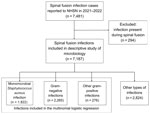
Figure. Flow diagram of postoperative surgical fusion infection cases in study of microbial etiology of postoperative spinal fusion infections and factors associated with gram-negative infections. NHSN, National Healthcare Safety Network.
We defined the unit of analysis (denominator) at the case level rather than at the isolate level. For patients with multiple positive cultures during a single SSI episode, we compressed duplicate bacterial species isolated from the same case and counted them only once. To analyze the independent predictors of different microbiological profiles, we categorized cases into 3 mutually exclusive, hierarchically defined analytic groups on the basis of the identified organisms. We categorized any case in which S. aureus was isolated as the sole microbial etiology as monomicrobial S. aureus infection (the reference group). The category of gram-negative infection consisted of all cases in which >1 gram-negative bacterial organism was isolated, regardless of whether it occurred as a monomicrobial infection or as part of a mixed/polymicrobial infection (i.e., coisolated with gram-positive organisms). Last, we categorized any case in which >1 gram-positive bacterial species were isolated without the presence of any gram-negative bacteria, S. aureus, or Enterococcus species as other gram-positive infection. The third cohort served as an exploratory group to approximate the profile of normal cutaneous flora. We excluded cases that did not meet the criteria for those 3 analytic categories or culture-negative cases from the multinomial regression model (Figure).
Statistical Analysis
We used frequency counts and percentages for categorical variables and used median (interquartile range [IQR]) or mean (SD) for continuous variables as appropriate. We performed a multinomial logistic regression analysis to determine the patient and procedural characteristics associated with the microbiological etiology of the infection. Our primary analysis evaluated the odds of a gram-negative infection compared with a reference group of monomicrobial S. aureus infection. To assess whether coinfection with other organisms influenced the observed effects, we performed a secondary analysis evaluating 2 additional cohorts within our model. The secondary analysis evaluated whether monomicrobial gram-negative and other gram-positive infections showed consistent results when compared with the same reference group. We followed that process to ensure the primary results were not driven by coinfections. The model simultaneously accounted for all patient and procedural covariates detailed above. We conducted analysis by using R version 4.3.2 (The R Project for Statistical Computing, httpw://www.r-project.org) and performed multinomial logistic regression using the multinom function in the nnet package. For multinomial logistic regression, the odds ratio (OR) can be interpreted as the multiplicative effect on the odds of infection relative to the reference group for a one-unit increase in continuous variable, or relative to the reference category for a categorical variable.
A total of 7,481 cases of spinal fusion SSI were reported to the NHSN during January 1, 2021–December 31, 2022. After excluding 294 (3.9%) cases because of the presence of infection during the initial fusion surgery, 7,187 cases remained for primary analysis. The mean patient age was 61.7 (SD 13.4) years; 54.1% were female (n = 3,889) and 45.9% (n = 3,297) were male (sex was unknown for 1 case). Most procedures were performed in an inpatient setting (n = 7,084 [98.6%]) and used a posterior surgical approach (n = 5,686 [83.7%]). The mean operative duration was 3.86 (SD 2.3) hours, and the median time from spinal fusion to infection diagnosis was 21 (IQR 14–29) days (Table 1).
Microbiology of Spinal Fusion SSI
Most cases were monomicrobial infections (n = 4,407 [61.3%]), 1,263 (17.6%) cases were polymicrobial, and the rest were culture-negative (1,517 [21.1%]). A total of 7,551 unique microorganisms were isolated among all cases reported to NHSN during the study period. Gram-positive bacteria were implicated in 53% (n = 3,813) of all cases. Staphylococcus spp. was the most prevalent bacterial genus, infecting 42.4% (n = 3,044) of cases. S. aureus was identified as the single most common pathogen, isolated in 30.6% (n = 2,200) of all cases (Table 2; Appendix Table). Gram-negative bacteria were implicated in 31.5% (n = 2,265) of cases; the most common species were Escherichia coli (n = 565 [7.9%]) and Pseudomonas aeruginosa (n = 501 [7.0%]). Fungi and mycobacterial infections were very rare;
Variables for Types of Infections
In multivariable multinomial logistic regression comparing gram-negative infections to a reference group of monomicrobial S. aureus infections, several independent predictors demonstrated significantly increased odds of a gram-negative etiology. Female sex was associated with 39% (95% CI 1.19–1.59) higher odds of gram-negative infection (p
Each additional hour of operative duration increased the odds of a gram-negative infection by 20% (OR 1.20 [95% CI 1.16–1.24]; pS. aureus.
A longer duration of time between the index procedure and diagnosis was associated with significantly lower odds of a gram-negative infection (OR 0.97 [95% CI 0.96–0.97] per day; pTable 3).
For monomicrobial gram-negative infections, female sex was also associated with higher odds (OR 1.38 [95% CI 1.19–1.59]; pTable 4).
Our study represents a large national surveillance-based analysis describing the contemporary microbial etiology of spinal fusion SSI. Our analysis of a national patient cohort showed gram-negative organisms made up nearly one third of all patient cases and organisms identified in diagnostic cultures for spinal fusion SSI. Among gram-negative bacteria, Enterobacterales (most commonly E. coli), and Pseudomonas spp. were the predominant organisms identified. Gram-negative bacteria have been previously reported to affect 30%–54% of infections, occurring more frequently in infections involving lower spinal levels, particularly lumbar and sacral instrumentation (5,6). The percentage is much larger than that reported for other orthopedic implant infections, such as periprosthetic joint infection, where gram-negative infection made up ≈11% of cases (7).
Consistent with previous literature demonstrating an anatomic gradient wherein lower spinal levels carry an increased likelihood of gram-negative organism involvement in spinal fusion SSI (8), our analysis further delineates multiple independent patient-specific and procedural variables that increase the probability of gram-negative pathogen involvement relative to monomicrobial S. aureus infection. Specifically, female sex, advanced age, higher BMI, prolonged operative duration, greater comorbidity burden, and emergency and trauma-related procedures were independently associated with a higher likelihood of gram-negative infection compared with infections involving monomicrobial S. aureus. The associations remained consistent in a secondary analysis restricted to monomicrobial gram-negative and monomicrobial S. aureus infections, demonstrating that the findings are not confounded by coinfecting organisms.
The precise underlying mechanisms driving the observed associations between those independent variables and gram-negative infections remain to be fully elucidated. Of note, our finding that trauma before spinal fusion independently correlates with a gram-negative etiology aligns with existing literature on fracture-related infections, which similarly demonstrate a high proportion of gram-negative infections (9). Those parallel clinical observations highlight a critical area for future prospective studies to investigate the specific pathophysiological pathways.
The strengths of this study include the use of a large, national dataset derived from the NHSN, encompassing thousands of spinal fusion SSI cases reported from multiple centers across the United States. This sample size exceeds that of most previously published studies, which have often been limited to single institutions or regional networks and therefore subject to potential biases because of local practice patterns, patient demographics, and institutional protocols. The multicenter nature of the dataset enhances the generalizability of our findings and provides substantially greater statistical power to detect associations among patient characteristics, surgical factors, and microbial etiology.
The first limitation of our study is that the reporting of spinal fusion SSIs to the NHSN is voluntary, introducing the possibility of reporting bias. Because the NHSN database only records infected episodes, the lack of an uninfected control group prevents evaluation of risk factors for development of infection. The use of S. aureus infections as the statistical reference limits generalizability because that cohort only involves those that already have infections. Because this national registry dataset contains only standardized, registry-submitted data, we lacked access to granular clinical details, such as specific perioperative antimicrobial protocols, antibiotic susceptibility profiles, use of allografts, instrumentation, and the precise anatomic source of the cultures. Furthermore, the redaction of key geographic and institutional variables, including facility size and type, prevented their inclusion in our multinomial models, limiting our ability to assess the variables that might have been pertinent. As an example, an outbreak of spinal fusion SSIs associated with the use of bone allografts infected with Mycobacterium tuberculosis that was reported in 2021 might not be fully captured in our study (10).
Because our cohort spans 2021–2022, our findings reflect pandemic-era practice patterns and case mixes. Institutional restrictions and altered clinical priorities during this period might have altered typical patient demographics and surgical volumes. As a consequence, those transient pandemic-era modifications could limit the generalizability of our results to current, postpandemic clinical practice
In conclusion, gram-negative infections account for nearly one third of spinal fusion SSIs and are associated with specific patient and surgical factors. The identification of independent factors related to gram-negative infections provides a practical foundation for transitioning from a universal approach to risk-stratified clinical decision-making. For researchers, specific high-risk cohorts highlight key target populations for future studies evaluating expanded gram-negative prophylactic regimens. For clinicians, using these risk profiles can guide timely, targeted empiric antimicrobial selection when spinal fusion SSIs occur, ultimately balancing optimal antimicrobial stewardship with tailored patient care
Dr. Lindstrom is a first-year clinical fellow at the University of Minnesota Division of Infectious Diseases and International Medicine. Her research interests are orthopedic infectious diseases, such as periprosthetic joint infections and postoperative spine infections.